Documentation Index
Fetch the complete documentation index at: https://docs.unpage.ai/llms.txt
Use this file to discover all available pages before exploring further.
You can use Unpage to automatically diagnose and fix many common build and
deployment issues, from dependency conflicts to test failures to configuration
errors.
Instead of manually digging through logs and debugging, your agent analyzes the
failure, applies a fix using Claude Code Headless Mode,
and opens a pull request for your review.
This keeps humans in control of what gets merged while eliminating the tedious
parts of build failure investigation. Your team stays unblocked, deployments
resume faster, and engineers can focus on reviewing solutions rather than hunting
for problems.
Example Build Failure
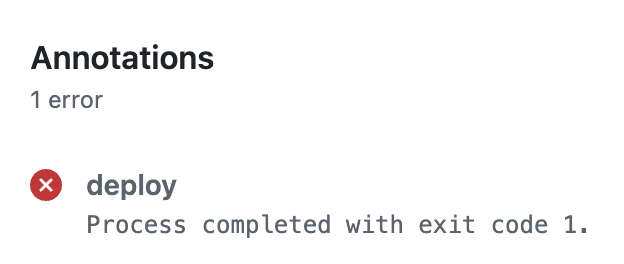
Creating A GitHub Actions Build Failure Agent
Let’s create an Agent that runs every time we get a GitHub Actions build failure
alert. Our Agent will extract the workflow and job details from the
alert, fetch the failing job logs, analyze the specific error, use Claude Code
to automatically fix the issue, and create a pull request with the fix.
After installing Unpage, create the agent by running:
$ unpage agent create failing_gha_build
A yaml file will open in your $EDITOR. Paste the following Agent definition
into the file:
description: Investigate a failed GitHub Actions workflow (on a main branch or a release; not relevant to pull request failures)
prompt: >
- Extract the repository name from the PagerDuty alert
- Use `shell_get_last_failing_run` to get the most recent failing GitHub Actions run ID for the repository
- Use `shell_fetch_run_logs` to fetch the complete logs from the failing run
- Use `shell_noninteractive_claude_code_run` to provide the error logs to Claude Code and ask it to fix the error
- If Claude Code successfully made a change, use `shell_commit_and_open_pull_request` to commit that change and open a pull request with Claude Code's explanation of the fix in the description for human review
- If Claude Code did not successfully make a change, log the output and stop - no automated action will be taken and human intervention is required
tools:
- "shell_get_last_failing_run"
- "shell_fetch_run_logs"
- "shell_noninteractive_claude_code_run"
- "shell_commit_and_open_pull_request"
Let’s dig in to what each section of the yaml file does:
Description: When the agent should run
The description of an Agent is used by the Router to
decide which Agent to run for a given input. In this example we want the Agent
to run only when the alert is about GitHub Actions workflow failures on main
branches or releases, not pull request failures.
Prompt: What the agent should do
The prompt is where you give the Agent instructions, written in a runbook
format. Make sure any instructions you give are achievable using the tools
you have allowed the Agent to use (see below).
The tools section explicitly grants permission to use specific tools. You can
list individual tools, or use wildcards and regex patterns to limit what the
Agent can use.
To see all of the available tools your Unpage installation has access to, run:
In our example we added several custom shell commands for GitHub Actions diagnostics:
shell_get_last_failing_run
shell_fetch_run_logs
shell_noninteractive_claude_code_run
shell_commit_and_open_pull_request
These are custom shell commands that use the GitHub CLI (gh),
Claude Code in Headless Mode,
and standard git commands to interact with GitHub Actions and automate fixes.
Custom shell commands allow you to extend the functionality of Unpage without
having to write a new plugin.
To add our custom GitHub Actions analysis and automation tools, edit ~/.unpage/profiles/default/config.yaml
and add the following:
plugins:
# ...
shell:
enabled: true
settings:
commands:
- handle: get_last_failing_run
description: Get the most recent failing GitHub Actions run ID for a repository.
command: gh run list --repo {github_repo} --status failure --limit 1 --json databaseId --jq '.[0].databaseId'
args:
github_repo: The GitHub repository in owner/repo format
- handle: fetch_run_logs
description: Fetch complete logs from a specific GitHub Actions run.
command: gh run view {run_id} --repo {github_repo} --log
args:
run_id: The GitHub Actions run ID
github_repo: The GitHub repository in owner/repo format
- handle: noninteractive_claude_code_run
description: Run Claude Code in non-interactive mode to analyze and fix GitHub Actions build errors.
command: |
cd {repo_path} && echo "{log_content}" | claude -p --append-system-prompt "The GitHub Actions build failed. Here are the relevant error logs from the failing run. Please analyze the error and fix the problem in the codebase."
args:
repo_path: The local path to the git repository
log_content: The relevant error logs from the failing GitHub Actions run
- handle: commit_and_open_pull_request
description: Commit changes and open a pull request with the fix.
command: |
cd {repo_path} &&
git checkout -b {head_branch_name} &&
git add -A &&
git commit -m "{commit_message}" &&
git push -u origin {head_branch_name} &&
gh pr create --title "🤖 Automated fix for failing GitHub Actions build" --body "{pr_description}" --base {base_branch_name} --head {head_branch_name} --repo {github_repo}
args:
repo_path: The local path to the git repository
github_repo: The GitHub repo on which to open the pull request
head_branch_name: The name of a branch to which the commit should be pushed
base_branch_name: The name of the target branch for the pull request
commit_message: A commit message to use for the single commit
pr_description: A description for the pull request
Shell commands have full access to your environment and can run the GitHub CLI
(gh) and git commands. Make sure you have the GitHub CLI installed and
authenticated (gh auth login) and that the repository is cloned locally.
See shell commands for more details.
Running Your Agent
With your Agent configured and the custom GitHub Actions automation tools added,
we are ready to test it on a real PagerDuty alert.
Testing on an existing alert
To test your Agent locally on a specific PagerDuty alert, run:
# You can pass in a PagerDuty incident ID or URL
$ unpage agent run failing_gha_build --pagerduty-incident Q1GHA7X8Y2Z9A3
Listening for webhooks
To have your Agent listen for new PagerDuty alerts as they happen, run
unpage agent serve and add the webhook URL to your PagerDuty account:
# Webhook listener on localhost:8000/webhook
$ unpage agent serve
# Webhook listener on your_ngrok_domain/webhook
$ unpage agent serve --tunnel --ngrok-token your_ngrok_token
Example Output
Your Agent will:
- Extract the repository name from the alert
- Query GitHub Actions for the most recent failing run ID using
gh run list
- Fetch complete logs from the failing run using
gh run view --log
- Use Claude Code to analyze the root cause and attempt an automated fix
- Create a pull request with the automated fix (if successful) for human review
- Provide detailed explanation of what was changed and why in the PR description
- Stop and wait for human intervention if no automated fix could be applied
The Agent transforms a disruptive build failure into an automated investigation
and fix attempt, creating a pull request for human review rather than automatically
merging changes, ensuring code quality while dramatically reducing time to resolution.
Production Deployment
To deploy this agent to production, see our Deployment Guide.